
The short answer
If your AC blows warm air, short-cycles, freezes up or makes new noises, it needs a diagnosis before the problem spreads to the compressor. We test the electrical, refrigerant and airflow sides, explain what failed, and give you repair and replacement options to choose from.
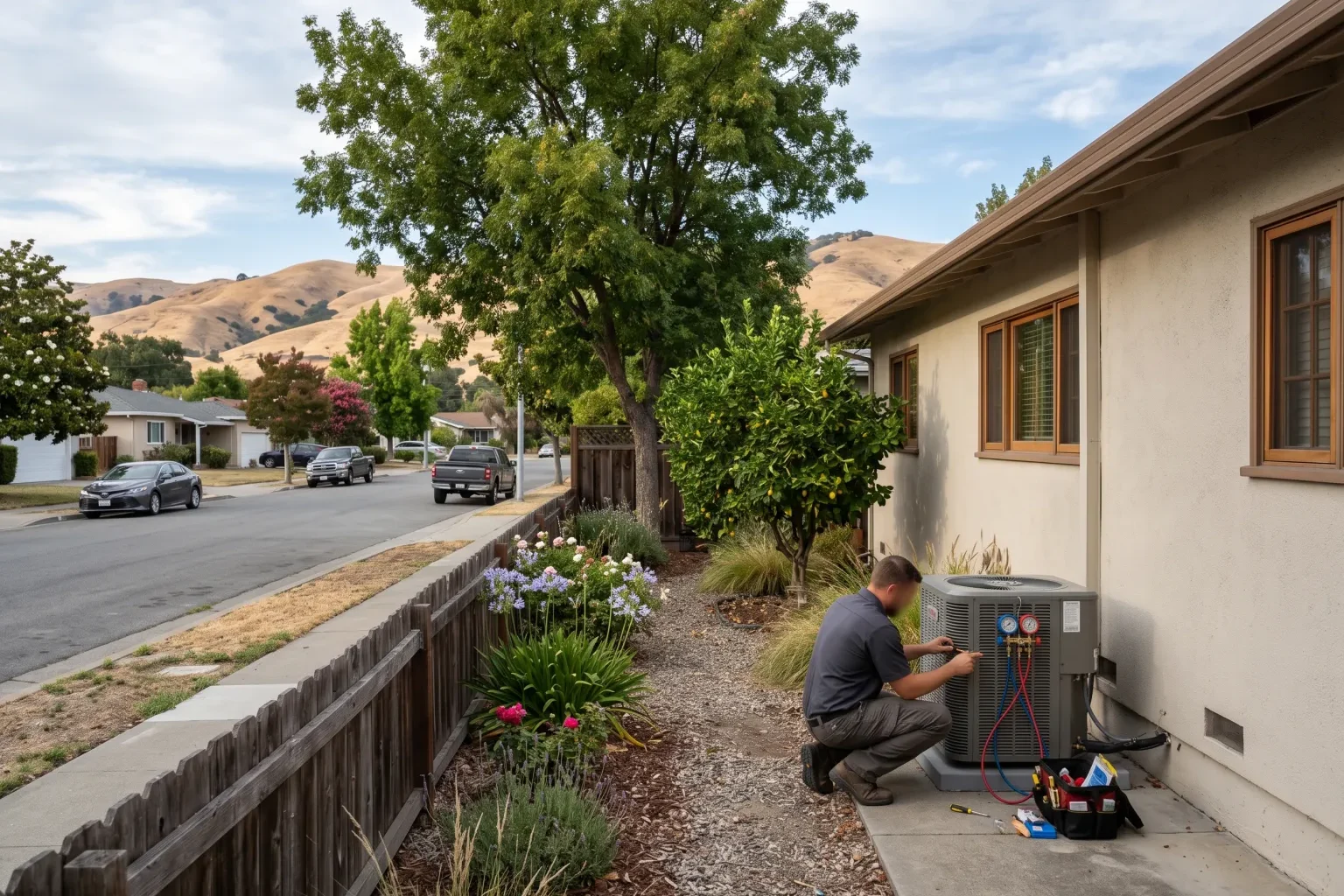
A San Ramon Valley summer can stretch from late spring well into October, with afternoons hot enough that a house heats up within an hour of the cooling quitting. Air conditioners here run long cycles, often in dusty, dry conditions, and that combination wears out certain parts in predictable ways. EliteFlow HVAC Repair Service diagnoses and repairs central air systems, heat pumps in cooling mode and ductless units for homes in Danville, Alamo, San Ramon, Dublin, Walnut Creek and nearby towns. This page explains the warning signs, what our technicians test, how we think about fixing versus replacing, and what to expect from the appointment itself.
Symptoms that call for a technician
Some issues are obvious, like a dead system on a ninety-degree day. Others creep up slowly, and homeowners get used to them until a small fault becomes a large one. Pay attention to any of the following:
- Air from the vents feels cool but not cold, or the house never reaches the thermostat setting by evening
- The outdoor unit hums but the fan does not spin, or the fan spins while the compressor stays silent
- Ice forms on the copper line at the outdoor unit or on the indoor coil
- The system turns on and off every few minutes instead of running steady cycles
- Water pools near the furnace or air handler, or a ceiling stain appears under an attic unit
- Buzzing, rattling, grinding or a squeal that was not there last season
- Electric bills climb even though your habits have not changed
What our technicians test
A cooling system has three parts that have to work together: the electrical controls, the refrigerant circuit and the airflow path. A problem in any one shows up as poor cooling, so we check all three rather than stopping at the first thing that looks wrong.
On the electrical side, we test the run capacitor, contactor, fan motor, compressor windings, disconnect and thermostat wiring. Capacitors in particular weaken with heat, and a weak one can let the compressor struggle to start for weeks before it fails outright.
For the refrigerant circuit, we read operating pressures and line temperatures, then calculate superheat and subcooling to judge whether the charge is right. Low charge means a leak somewhere, and we look for it at brazed joints, service valves and the coils rather than simply topping off.
Airflow gets the same attention. We check the filter, blower wheel, evaporator coil and return path, and measure temperature drop across the coil. A clogged filter or matted coil can freeze a perfectly good system, and fixing airflow is often cheaper than any part.
Fix it or replace it?
Most AC calls end in a repair. A capacitor, contactor, fan motor, drain cleaning or thermostat fix brings a system back without touching the major components. Those repairs are almost always worth doing.
The harder decisions involve a failed compressor, a leaking evaporator coil or a system that has needed several repairs in a row. In those cases we lay out the realistic paths: replace the failed component, replace the outdoor unit or coil, or replace the full system. We describe what each path means for comfort, efficiency and how long the rest of the equipment is likely to last.
Some owners use a major failure as the moment to switch to a heat pump, which cools in summer and heats in winter. Nothing requires that change, but it is worth comparing, especially if your furnace is also older. BayREN and local clean energy providers sometimes offer electrification incentives; amounts change by funding cycle, so we confirm the current offer before including it in any comparison.
What shapes the cost of a repair
We give you a specific quote after the diagnosis, but it helps to know what moves the number up or down:
- Which part failed: a small electrical component versus a coil or compressor
- The refrigerant your system uses, since older types are harder to source
- Where the equipment sits: a tight attic or steep side yard takes longer to work in
- Whether a leak has to be located and repaired before recharging
- Access to parts for your brand and model
Keeping the next breakdown away
Many of the repairs we make in July could have been caught in April. Outdoor coils in the valley collect a surprising amount of dust, dry leaves and seed fluff over a single season, and a coated coil forces the compressor to run hotter and longer. Rinsing the coil gently with a garden hose, keeping shrubs trimmed back a couple of feet, and changing the indoor filter on schedule all reduce strain on the equipment.
A yearly spring checkup goes further. The technician tests the capacitor before it fails, tightens electrical connections that loosen with heat, flushes the condensate drain so it does not back up into a ceiling, and confirms the refrigerant charge is still where it should be. On a system that already needed one repair, that visit is the easiest way to spot the next weak part before a heat wave finds it for you.
If your home has a heat pump, the same unit handles winter heating too, so checking it twice a year, once before summer and once before the cold months, makes sense.
How a repair appointment goes
When you book, we ask what the system is doing, roughly how old it is and where the indoor unit is located, so the technician can bring likely parts. On arrival, the technician talks with you about the symptoms, then works through the electrical, refrigerant and airflow checks described above.
Once the cause is clear, you get an explanation and the options, with a price for each, before any work begins. Many repairs are finished on the same visit. If a part has to be ordered, we make the system as safe and usable as possible in the meantime and schedule the return. Before leaving, the technician runs the system through a full cycle, confirms it is cooling properly and gives you a written summary.
AC Repair by city
- AC Repair in San RamonLocal service & repairs
- AC Repair in DublinLocal service & repairs
- AC Repair in PleasantonLocal service & repairs
- AC Repair in ClaytonLocal service & repairs
- AC Repair in Walnut CreekLocal service & repairs
- AC Repair in LivermoreLocal service & repairs
- AC Repair in MoragaLocal service & repairs
- AC Repair in LafayetteLocal service & repairs
- AC Repair in ConcordLocal service & repairs
- AC Repair in AntiochLocal service & repairs
- AC Repair in Pleasant HillLocal service & repairs
- AC Repair in BrentwoodLocal service & repairs