
The short answer
Consider a new furnace when repairs are getting frequent, the heat exchanger is compromised, or the unit no longer heats the house evenly. We size the replacement to your home, inspect the ducts and venting, and explain how Bay Area Air District rules may affect future choices.
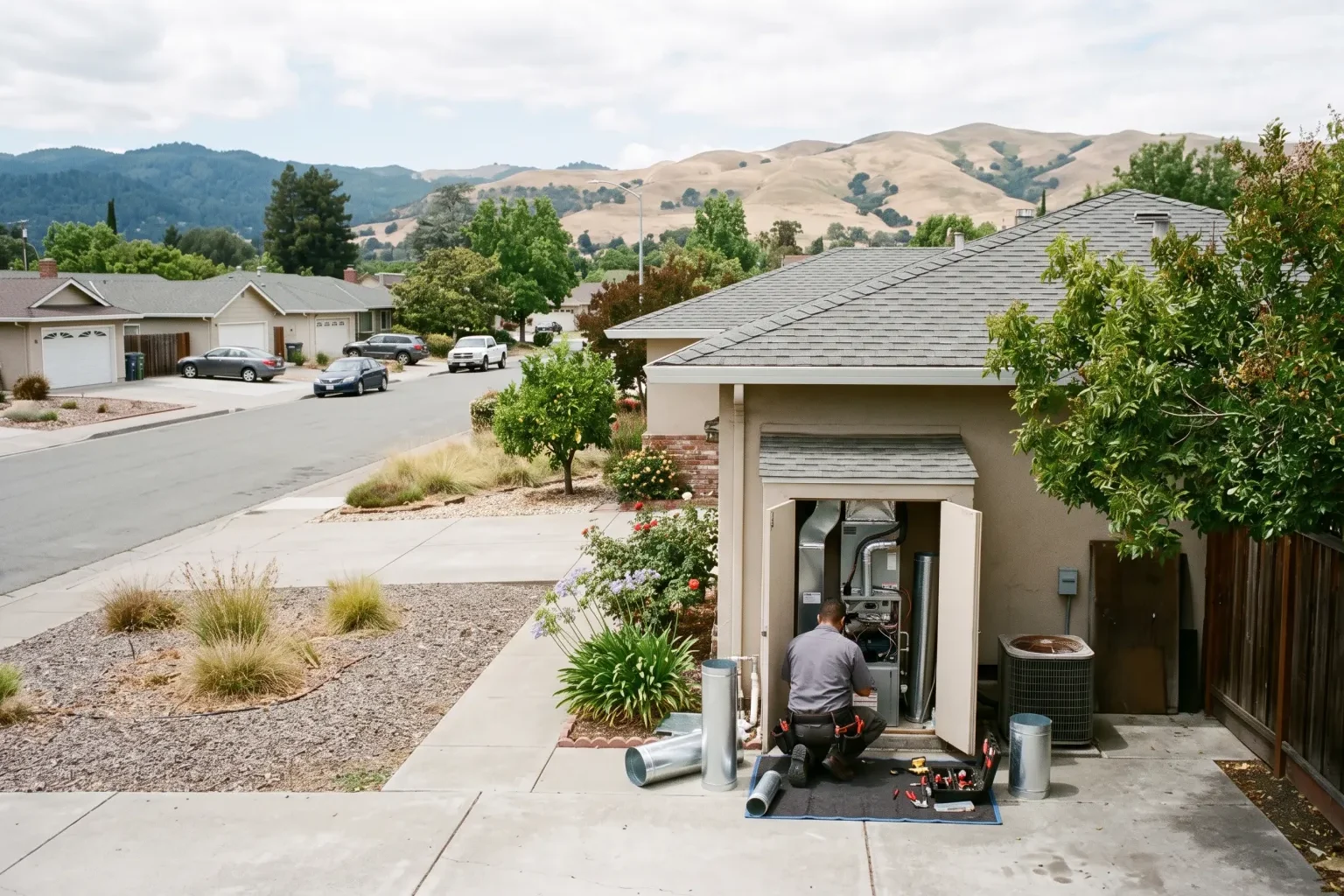
Replacing a furnace is one of the few home projects most people face only once or twice, so it is reasonable to feel unsure about the right move. EliteFlow HVAC Repair Service installs gas furnaces and helps Danville homeowners weigh them against electric heat pump options, with the house, the budget and the coming Air District rules all on the table. Furnaces in this part of Contra Costa County tend to live in garages, attics and hall closets, and many of them were sized decades ago for a home that has since been remodeled, re-windowed or expanded. A new unit is a chance to correct that. Below you will find the warning signs that a furnace is nearing replacement, the checks we run before recommending equipment, how replacement compares to another round of repairs, what drives the scope of a job, and how the installation itself unfolds.
Signals that your furnace is approaching the end
Furnaces rarely quit without warning. More often, they give months of hints: a burner that takes several tries to light, a blower that sounds harsher each winter, or a monthly gas bill that creeps up even though the thermostat setting has not changed. Because San Ramon Valley winters are mild, a furnace here may run fewer hours than one in a colder state, but age still wears down igniters, inducer motors, control boards and the heat exchanger itself.
Pay particular attention to anything involving combustion. Soot around the burner area, a yellow or lazy flame, or a carbon monoxide alarm are reasons to shut the system down and call for an inspection right away.
- Repair visits every season, often for different parts
- Rooms at the far end of the house never warming up
- Rust, cracks or scorching visible on the cabinet or flue
- A burning or metallic odor that lingers after startup
- Short cycling, where the furnace turns on and off rapidly
- Parts that are discontinued or hard to source for your model
How we evaluate the house before recommending equipment
We start with a heat loss calculation rather than simply matching the size of the old unit. Square footage, window area, insulation levels and ceiling heights all factor in. An oversized furnace heats quickly but cycles constantly, wasting fuel and leaving temperature swings; an undersized one runs nonstop on the coldest nights.
The ducts get the same scrutiny. A new furnace connected to leaky or undersized ductwork will never deliver its rated performance. We check static pressure, look at return air capacity, and inspect visible duct runs in the attic or crawlspace for disconnections and crushed sections.
- Heat loss of the home, room by room where needed
- Duct condition, sealing and return air sizing
- Venting type and whether the flue suits a high-efficiency unit
- Gas line size and shutoff valve condition
- Condensate drainage for high-efficiency models
- Clearances and access in the closet, attic or garage location
- Thermostat compatibility and wiring
Repair it again or replace it now
We are glad to repair a furnace that has years left in it. A failed igniter, flame sensor or pressure switch on an otherwise sound unit is usually worth fixing. The calculation changes when the heat exchanger is cracked, when major components like the inducer and control board are failing together, or when the unit is old enough that the next breakdown is predictable.
Timing matters for another reason. Under Bay Area Air District Rule 9-4, natural gas furnaces manufactured from 2029 must meet a zero-NOx emission standard, which in practice points homeowners toward heat pumps when a furnace is replaced after that date. The rule does not force anyone to remove working equipment; it applies only when a furnace fails or is replaced. Some Danville homeowners choose a new high-efficiency gas furnace now, while others use this replacement as the moment to switch to a heat pump. We lay out both paths so the decision is yours.
What determines the scope and cost of a furnace installation
Every quote we write is based on the house in front of us, so we do not list prices here. The equipment itself is only part of the picture. A straight swap of a standard-efficiency furnace in an accessible garage is a very different job from moving to a condensing furnace in a tight attic that needs new venting and a condensate line.
Ductwork and access are the two items that most often change scope. If the existing ducts leak heavily or the return is undersized, correcting that during installation is usually the most effective time to do it.
- Furnace efficiency and whether it uses single-stage, two-stage or modulating burners
- Variable-speed blower versus standard blower
- Venting changes, especially when converting to a condensing unit
- Attic, closet or garage location and how easy it is to reach
- Duct repairs, sealing or return air improvements
- Gas line, electrical or thermostat upgrades
- City permit and inspection requirements
What installation day involves
Most furnace replacements take a day. The crew lays down floor protection along the path to the furnace, shuts off gas and power, and disconnects and removes the old unit. The new furnace is set in place, connected to the plenum and ductwork, vented, piped to gas and wired to the thermostat.
Before calling the job finished, we check for gas leaks, measure temperature rise across the heat exchanger, verify that the venting drafts correctly, and confirm blower settings match your duct system. You get a walkthrough covering filter location and size, thermostat operation and the basic signs that something needs attention. The old furnace is hauled away, and we help coordinate the city inspection where a permit applies.
A few weeks after installation is a good time to notice how the house feels. Rooms that used to lag should warm more evenly, and the furnace should run longer, steadier cycles instead of short bursts. If a bedroom still runs cool, a damper adjustment or a register change is often all it takes, and we would rather hear about it early than have you live with it through a whole winter.